Market Recap
In the second quarter of 2025, global markets faced a complex mix of encouraging economic data, ongoing geopolitical uncertainty, and evolving global central bank policies. Nonetheless, the S&P posted a strong gain, reaching a new all-time high, and fixed-income markets were positive across most segments.
The S&P 500 gained 10.94% in the second quarter, driven by continued earnings resilience in the technology and communication services sectors. Year to date, the index is up 6.2%. The Nasdaq posted a stronger 17.96% return for the quarter, lifted by optimism around AI-driven productivity and corporate investment in cloud infrastructure. Small-cap stocks also moved higher in the three-month period, gaining 8.5% (Russell 2000).
Internationally, developed market performance was also strong gaining 11.78% (MSCI EAFE). Importantly, most of this return is due to currency effects, specifically a weaker U.S. dollar. (In local currency, returns were 4.8%.) Emerging markets rose 11.99% (MSCI EM) benefiting from improving sentiment around China’s fiscal stimulus and currency stabilization efforts. Geopolitical risks, including ongoing instability in Eastern Europe and the Middle East, remain potential catalysts for volatility.
Within fixed-income, my expectation has been that rates will remain volatile and range bound, which played out in the second quarter. The 10-year Treasury yield started the quarter at 4.23% and ranged between 4.01% and 4.58% before ending the quarter at 4.24%. In the period, investment-grade core bonds ended the quarter up 1.21% (Bloomberg US Aggregate Bond). Lower quality high-yield bonds were up 3.57% (ICE BofA US High Yield) as investors’ appetite for risk increased.
Investment Outlook and Portfolio Positioning
At their mid-June meeting, the Federal Reserve held the federal funds rate steady at 4.25–4.50%, marking the fourth consecutive meeting without a change in rates. Chair Powell again emphasized a data dependent approach, citing risks from tariffs and global uncertainty, particularly inflation pressures from U.S. tariffs. The Fed also updated their summary of economic projections where the key takeaway was that the median forecast is still for two quarter-point rate cuts by the end of 2025. However, we did see some division within the Fed, where seven of 19 officials now see no cuts this year, implying that they believe the economy is stable and rates are not too restrictive.
The Fed’s rate decisions are based on their dual mandate of stable prices and maximum employment. My view is that inflation, from a structural perspective, remains under control. For example, the Consumer Price Index (CPI) ex-shelter, has been below the Fed’s 2% target in 19 of the past 24 months, underscoring the disinflationary trend in much of the economy. While upcoming tariffs may temporarily push inflation higher, the Fed is likely to look through these shorter-term effects and focus on the underlying structural picture, which I think remains benign.
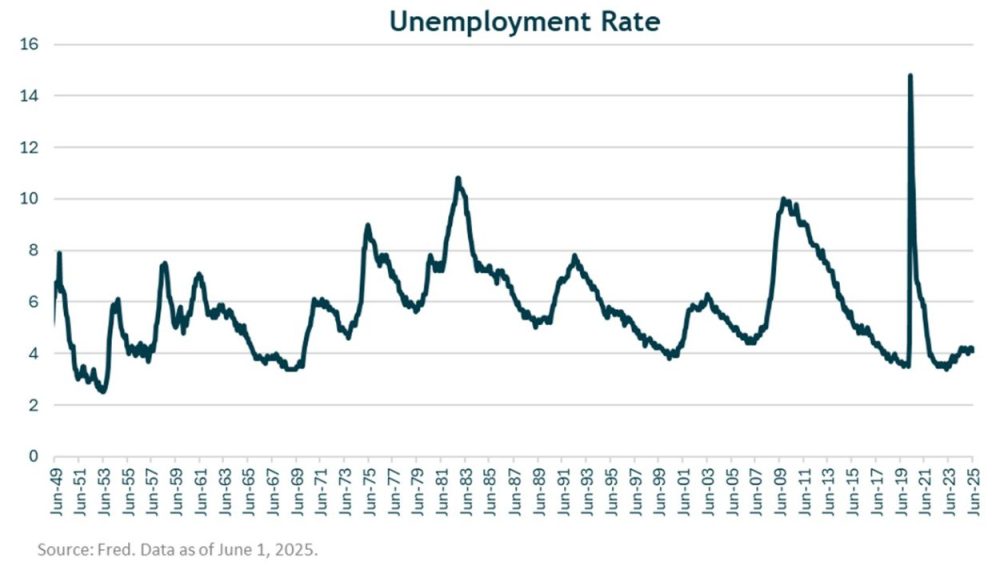
As for the labor market, it is showing signs of slowing and is not likely to improve meaningfully considering the rise in deportations. Unemployment ticked up modestly to 4.1% in June, and job openings have declined across several sectors. Fed officials expect unemployment to rise to 4.5% this year (from 4%) and settle at 4.4% in 2027. Wage growth remains above pre-pandemic trends but has decelerated, which could provide relief for the Fed’s inflation mandate in the coming quarters.
Looking at economic growth, U.S. GDP growth in the second quarter is estimated to have reaccelerated to 2.5% annualized after contracting 0.2% in the first quarter. (This is according to the Atlanta Fed as of July 1, 2025.) The first quarter’s GDP decline was primarily due to a surge in imports ahead of the tariff announcement (imports are a subtraction in the GDP calculation). The Bloomberg consensus estimate for 2025 GDP growth is 1.4%. Consumer spending, though still positive, has recently shown some signs of fatigue as households continue to adjust to higher borrowing costs and tighter credit conditions.
I expect the U.S. economy to slow in the near term but continue to believe it can avoid a meaningful downturn and ultimately regain momentum over time. With core inflation continuing to trend toward the Fed’s 2% target (albeit slowly) and clearer signs of economic and labor market softening emerging, I believe the Fed now has room to begin cutting rates. The timing and pace of those cuts remain uncertain, but in my view, the case for easing has become increasingly compelling to support the slowing economy.
So far, the uncertainty and angst surrounding the tariffs has mainly impacted market sentiment and not corporate fundamentals. First quarter’s earnings wrapped up with a strong showing, growing over 13% compared to a consensus forecast of mid-single digit growth at the start of earnings season. While U.S. equity valuations are undeniably elevated by historical standards, that alone does not imply an imminent correction. Valuations have long proven to be poor timing tools, and in the context of where we are today, I believe U.S. (and global) stocks have room to grind higher through the remainder of the year.
Outside the U.S., valuations for international stocks remain attractive, and are currently trading at a meaningful discount (i.e., cheaper) compared to U.S. stocks. After gaining 20% through the first half of the year (MSCI EAFE Index), I see potential for select international exposures to continue performing well, particularly if the U.S. dollar continues to weaken alongside Fed policy shifts.
In fixed income markets, U.S. Treasury yields moved modestly lower across most of the yield curve during the quarter, reflecting growing expectations that the Federal Reserve may soon begin cutting rates. The 10-year yield declined approximately 20 basis points over the quarter, ending near 4.20%, while the 2-year yield fell slightly more, reflecting anticipation of rate cuts by year-end. The curve was slightly inverted at the end of June, a signal of shifting market sentiment toward a softer economic trajectory.
Investment grade corporate bonds and high-yield bonds have both posted solid returns year to date, and spreads have remained broadly resilient. While I suspect economic growth will slow, this does not necessarily spell trouble for bond markets. A moderate slowdown can be supportive, as it eases inflation pressures and interest-rate volatility, both of which help maintain credit stability and investor demand.
I continue to see opportunities for active management in the fixed income positioning, both from an asset allocation standpoint, and manager selection. I expect 10-year Treasury yields to remain rangebound between approximately 3.8% to 4.6% and have been trading around these ranges, shortening duration last year when yields were in the upper 3% range and dadding back duration recently when rates were in the mid-4% range. Moreover, the active managers I’m using in the portfolios continue to find attractive yield opportunities across credit (including high-quality and selective high-yield exposure) and securitized markets, allowing to capture attractive income without overreaching for return and helping narrow the range of portfolio outcomes in an environment of still-evolving macro conditions.
Closing Thoughts
The second quarter’s equity rebound reflects growing investor optimism that a soft landing remains likely, with inflation easing and central banks, particularly the Fed, gaining room to cut rates. In the U.S., equity performance continues to be led by a narrow set of large-cap growth/technology stocks, though market breadth has improved modestly from last year.
Outside the U.S., valuation discounts for international stocks remain meaningful relative to the U.S., but currency dynamics and geopolitical uncertainty continue to present near-term risks. I see potential for international exposure to outperform, particularly if the dollar continues to weaken alongside Fed policy shifts.
As we enter the second half of 2025, my outlook remains constructive but cautious. I believe markets will continue to be shaped by a tug of war between slowing economic growth and the prospect of rate relief alongside further resolution to the tariff situation and the upcoming legislation. I continue to think economic growth will slow but not collapse. Themes to watch in the remainder of the year will be Fed policy shifts, corporate earnings strength, and geopolitical risks.
As always, I remain committed to helping you navigate this dynamic environment with a disciplined, long-term approach. I appreciate your trust and support.
Jeff (7/9/2025)